
Individual or Empire? Should we remain individual scientists or should I forge or join a research group for pursuing research. This is not an age old question, if we reckon the time span of human thought and scientific inquiry.
Science, until recently, has been an individual pursuit. There are reasons in our history and her-story on how it became a group pursuit. Industrial revolution, academic institutions, World Wars, funding based research, scientists (and Science) migration, state-run funding agencies, peer review, Ph. D. degree, academic business models, tenure track, publish or perish, research grants, proposal based funding, funding based Science, post docs, research sans teaching professors, research empires, professors as research managers, quantity as quality, scientists as entrepreneurs, students as workers, the sequence is telling.
But Individuals remain. Why? Because the Individual and the Empire are part of the academic social order as it strives for growth, writes Prof. Bejan [1]
Empire building is a phenomenon that dominates todays research landscape. Large groups, national priorities and research centers dwarf the spontaneous individual investigators. Administrators and the thirst for higher rankings encourage this trend. Yet, the individuals do not disappear. This paper explains why.
When a paper abstract begins that way, most of us are hooked. Let me summarize the contents of [1] here.
Any research academic organization is made of A population of researchers (faculty, scientists) and usually comprising of research groups (at least one represented by A1) and the remaining individuals A0. The symbol A mean all the properties (the magnitudes) that differentiate between a small A0 and a large A1, for example, numbers of researchers, floor space, paid salaries, and the cost of pursuing the projects located on A0 and A1. The idea is represented in the accompanying figure.
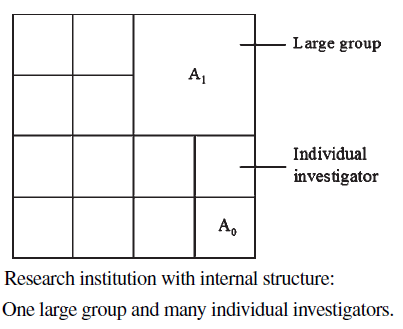
Figure adapted from [1]
Constructal Theory proposed by Prof. Bejan [2] is an idea that is ten years young [3]. The theory by using a double optimization method, states for a finite-size flow system to persist in time (to survive) it must evolve such that it provides easier and easier access to its currents. That the generation of design (configuration) in nature is a physics phenomenon and can be predicted by theory is the colophon (see End Note).
The shapes or geometry of a variety of structure in nature and engineering is attempted using the theory. Examples include [4] heat sink designs cooling electronics, natural tree shapes, river basins, shape and size of road networks, Zipf function, Pyramids, social networks. In the context of the paper [1] that is related to social dynamics and networks, the theory states
[…] the institution is a flow system with architecture, which evolves in time so that its streams flow with progressively greater ease
More people, ideas and information flow through it, more visible (V ) an institution becomes. Obviously for this to happen, two properties are necessary, Production P of good creative ideas and its publishing and Support S, funding, shelter and peace for the special individuals who are creative.
Regarding Support, to quote from the paper [1],
A reasonable assumption is that the support Si received by the research unit Ai is proportional to the size of the unit. This is true if one thinks of size as being represented by salaries, or by the number of those who work on Ai. The struggle for research grants, however, reveals a bias toward larger grants.
Often we have observed in our institutions, bigger funds goes to bigger research groups (A1). What size is big depends on the size of the institute A. It is encouraged by the funding agencies to form big groups with a director and a team of researchers. Sometimes such teams reduce to a professor and a group of assistant (to) professor(s). So, to increase Support S for an organization, it is lucrative to form large research groups. The administration of organizations usually offer internal incentives (promotions etc.) to form such groups to maximize their Support. It is an open secret - particularly in the USA - that one should ‘network’ to succeed in academia. Compared to such networks, the individual investigators have lesser funding chance.
But S alone doesn’t contribute to the growth of an organization. Because S is not P, the Production of good creative ideas and its flow in an out of the organization.
Each organization is marked by its Visibility (V) or how renowned it becomes. This depends on P and S. One could expect then bigger a research group that is formed within an organization and more such groups, more S and more P. With simple analysis (algebra), the author shows in [1] that the formation of the big group (A1, see above figure) actually has the opposite effect on global support (S) and global idea production (P). By constuctal theory arguments, it is shown in [1] that for maximizing the visibility V of an organization, both the group (A1) and the individuals (A0) are required to keep doing what they are good at. They don’t need to swap places or migrate towards the other.
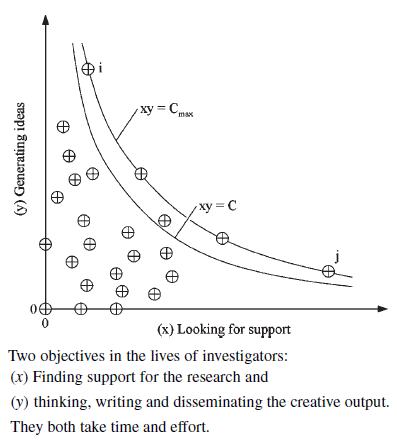
Figure adapted from [1]
To explain this without the involved equations, observe the accompanying figure.
It identifies the individual position (marked by the plus symbols) of the creative folk of an hypothetical organization. The Visibility, since it is a product of Support and Production of ideas (V = SP), can be traced as an hyperbola in this plane. The global objective for the organization, as it grows, is to acquire maximum visibility in time. This objective requires each of the position to move as far away as possible from the origin. Because, for each position in the S-P plane will be connected by a hyperbola (xy ~ C) and an unique hyperbola that traces the maximum visibility (C = Cmax) at a given time of life of an organization. The visibility of each creative individual, depending on the choice of how to spend her professional time, is identified with a position in the S-P plane (C ≤ Cmax). Importantly, it doesn’t matter whether one grows by moving along the abscissa or the ordinate. Improving their visibility by pushing their hyperbola towards the maximum, already makes them contribute to the global objective - the Visibility of the organization.
Individuals will not vanish. And neither they need to coalesce into large research groups to maximize the global objective of the organization. By being creative and Producing ideas, they will still serve the organization, with or without Support.
The later part of the paper discusses the necessary conditions for emergence of a large group in an organization. I shall skip it for brevity of this note. However, substantial portions of the Conclusions of the paper is worth quoting
The theoretical framework proposed in this paper explains […] self-organization in contemporary research: […]
From the individuals perspective, the counting of the large-group idea (e.g., one scientific paper) on the same basis as one idea-paper published by an individual investigator is openly unfair. The single paper produced by the group required N1 paid salaries, not one, i.e., a lot more than one idea-paper produced by one individual. In Fig. 2 then, the y value of professor j should be divided by the average number of coauthors that appear on js papers.
Here is why researchers should be interested in the self-organization phenomenon discussed in this paper:
First, the apparent conflict between research empires and individuals is not a conflict: it is a balance that serves the institution as a whole.
Second, the idea that one can predict research self-organization on the same basis as design in nature and engineering is worthy of discussion, especially among researchers.
Finally, or I should say firstly, those who coerce their colleagues into large groups (to generate funding, and to beef up their own CVs) are acting against the self-organizing nature of the institution, i.e., against the global interest. Complete coalescence into large groups does not happen and will not happen.
I think the conclusions are valid for organizations that value and thrive on creative work. Organizations such as objective educational institutions.
Finally, the paper is not about regimented work and organizations that morph to do such work. A poignant note from [1]
The creative are not workers in a factory, or slaves on a plantation. Their own creativity defines the work and the institution. If the work is predefined (prioritized, planned, dictated), as some administrators mold their institutions nowadays, then the work is not creative, and it is not the subject of this article.
Having observed the growth of some organizations and their adopted means for achieving that growth, I enjoyed reading the paper. One of the instances that a ‘research paper’ made me smile.
End Note: Constructal Theory is not explained in detail in this note. If interested, browse [4], or read [2] and [3].
References
- Constructal Self-organization of Research: Empire Building Versus the Individual Investigator, A. Bejan, Int. J. of Design Nature and Ecodynamics. Vol. 3, No. 3 (2008) 113.
- Shape and Structure, A. Bejan (2001) - Amazon Link
- Design with Constructal Theory, A. Bejan (2008) - Wiley Link
- Constructal Theory Website http://constructal.org.