
About this note
A plain-language retelling of my chapter on Josef Stefan, written for the book marking the 175th anniversary of his birth. The full citation is under Reference. Three older notes go deeper into each of his heat transfer contributions; they are linked in the sections below.
An individual, not an empire
Should a scientist work alone, or build and join a research group? For most of history science was an individual pursuit. Industrial revolution, academic institutions, world wars, funding agencies, the PhD degree, tenure tracks and “publish or perish” have since turned it largely into a group enterprise, and research empires now dominate the landscape. Yet individuals remain. Josef Stefan (1835 to 1893), an Austrian physicist whose nationality and native language were Slovenian, is an outstanding example of such an individual, and his legacy holds lessons for how we do research and teach today.
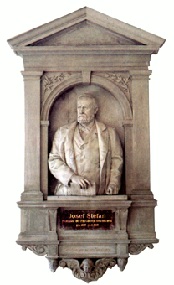
Bust of Josef Stefan at the University of Vienna.
Stefan worked on many problems, but three of them shaped heat transfer as we know it: he measured the thermal conductivity of a gas, he found the law that links radiated heat to temperature, and he solved the problem of how fast ice grows. Each is a story of reasoning from imperfect knowledge to a correct result.
Measuring the unmeasurable: conduction in gases
In the mid-nineteenth century it was not even settled whether gases conduct heat. Priestley in 1780 thought he had measured “the power to conduct heat” of gases but had really measured their specific heat. Count Rumford, trying the same in 1786, stumbled instead on a new mode of heat transfer, convection, and concluded that gases do not conduct heat at all; his reputation kept that belief alive until Magnus showed in 1861, with electrically heated platinum wires, that they do. Maxwell’s kinetic theory of gases (1860) gave a theoretical value for the thermal conductivity of a gas, but Maxwell also declared that it could never be measured directly, because radiation from the gas would always swamp conduction, even with convection suppressed.
Stefan set out to prove him wrong. His early attempt, a column of air heated from the top and cooled from the bottom so that it would not convect, failed because he could not control the heat lost to the surroundings. His answer was an instrument he called the diathermometer. A thin layer of gas sits in the narrow gap between two concentric cylinders, too narrow for convection to start. Instead of waiting for a steady state, Stefan made a transient measurement: the heat conducted across the gap, given by Fourier’s law, was equated to the energy gained by the gas enclosed inside, and since for a gas at fixed volume the relative change in temperature equals the relative change in pressure, he could follow the energy gain with a simple manometer.
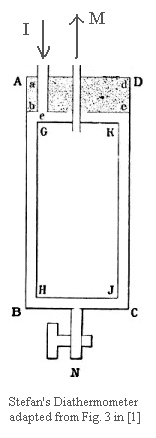
Part of Stefan’s diathermometer. Gas fills the narrow gap between the concentric cylinders, and the manometer limb M records the pressure in the inner chamber.
He measured the thermal conductivity of air as 0.0234 W/mK, within 11% of today’s accepted value of 0.0263 W/mK and within about 7% of Maxwell’s own theoretical figure, and went on to measure hydrogen, nitrous oxide, methane, carbon monoxide and carbon dioxide. The details are in Stefan and the Diathermometer.
Finding the fourth-power law: radiation
By Stefan’s time it was agreed that radiated heat is not simply proportional to temperature difference, but nobody knew the right relation. In 1817 Dulong and Petit had cooled a hot mercury container inside an evacuated chamber, extrapolated their cooling rates to zero pressure, and proposed an empirical radiation formula on the belief that conduction and convection had been removed.
The diathermometer had taught Stefan that the conductivity of a gas does not depend on its pressure. Lowering the pressure suppresses convection, but not conduction, so Dulong and Petit’s “pure radiation” data must still contain a conduction contribution. Stefan estimated it at 10% to 50%, the larger share for the silvered container, which (as we now know) radiates less. Correcting for it, and working with absolute temperature, which Dulong and Petit had missed, he found that the data fitted a law in which radiated power rises as the fourth power of temperature.
He did not stop at one data set. He tested the law on Tyndall’s measurements of a platinum wire heated from red heat (about 525 °C) to white heat (about 1200 °C), where the radiation rose about 12 times against the 11.6 the law predicts, and on data from Draper and Ericsson. Applying it to measurements of sunlight, he estimated the temperature of the Sun at 5580 to 5838 K from Soret’s data, the first good estimate and close to today’s 5770 K, where earlier estimates from the same kind of data had ranged from about 1700 to 2550 K. The law was not readily accepted until Boltzmann, Stefan’s first doctoral student, derived it from theory, and it is now the Stefan-Boltzmann law.
Some later writers dismissed Stefan’s claim, pointing out that platinum is not a black body and that its radiation does not follow the fourth-power law. Such criticism, made with knowledge Stefan could not have had, is what Clifford Truesdell called intellectual under-cutting. We do not call Darwin wrong for not knowing about genes. Stefan grasped the importance of absolute temperature and tested his law against several independent data sets over a wide range of temperatures before proposing it. The full story is in Stefan and the T to the fourth power law.
How fast does ice grow? Phase change
British and German Arctic expeditions of the 1860s recorded, from ships frozen into winter quarters or drifting with the ice, how thick the sea ice grew and how cold the air was. From these records Stefan formulated what is now called the Stefan problem: how fast does a solid layer grow, or melt, when its boundary moves with time?
His first answer was simple and lasting. Water at the freezing point gives up its latent heat as it solidifies, and that heat must be conducted up through the ice already formed to the cold air above. Balancing the two shows that the ice thickness grows as the square root of time. Stefan wrote a series of papers on the problem, relaxing his assumptions step by step (for example, letting the air temperature vary with time), solving the full transient problem with a moving boundary, and comparing his results with the expedition records. Others had touched the problem before him (Joseph Black identified latent heat in 1762, and Franz Neumann lectured on moving boundary solutions around 1860), but Stefan’s name stuck. The ratio of sensible to latent heat of a material is today called the Stefan number, and numerical codes for melting and freezing, including those for the phase change heat sinks we have designed to cool electronics, are still checked against his solution. See Stefan and the Polar Ice Caps.
Stefan the professor
Stefan was a warm and beloved teacher. He gave animated lectures that left him exhausted, and kept a collegial atmosphere in a cramped, underfunded institute on Erdbergstrasse, far from the main university buildings. Boltzmann later wrote that Erdberg stayed with him all his life “as a symbol of serious, inspired experimental activity”. When the young Boltzmann came to him, Stefan did not teach him what was already known. He handed him Maxwell’s papers and, since Boltzmann knew no English, an English grammar. Stefan made his students learn a subject rather than merely study it. Sigmund Freud, another of his students, regarded him as a brilliant theorist and experimenter, and Stefan stressed to them the interdependence of theory and practice.
He was, in the true sense, a professor: one who professes a subject and lives it, neither only a teacher nor only a researcher. He often slept in his laboratory, had little social life, and never seems to have left Austria for his work, the one thing Boltzmann complained of. His papers were models of precision. Where his contemporaries wrote in narrative, Stefan expressed observed effects as concise equations, stated the exact conditions under which his experiments could be repeated, and listed his sources of error with bounds on their size. He was neither only an experimenter nor only a theorist, but a rare combination of both.
Why Stefan still matters
Stefan’s three great results came from one habit of mind: he took what was known, right or wrong, reasoned carefully about what it implied, and checked it against measurement. His diathermometer turned a supposed impossibility into a measurement; that measurement exposed a flaw in old radiation data and led to a new law; and his analysis of polar ice gave engineers a benchmark that is still in use. In an age of research empires and of slotting ourselves as theorists or experimentalists, his life reminds us to remain both a scientist and a student.
Related
- Stefan and the Diathermometer, Stefan and the T to the fourth power law and Stefan and the Polar Ice Caps: detailed notes on each of Stefan’s heat transfer contributions
- Individual or empire, in academics: the question that opens the chapter
- Phase Change Material Applications: where the Stefan problem meets electronics cooling
Reference
Narasimhan, A., (2013), “The Scientific Legacy of Josef Stefan,” Chapter 11, pp. 200-220, in Jožef Stefan: His Scientific Legacy on the 175th Anniversary of His Birth, ed. John Crepeau, Bentham Press. [DOI: 10.2174/97816080547701130101 | Product Link]